



What Are Plastic Bakery Trays?
Plastic bakery trays are reusable plastic trays used to cool, store, stack, handle, and transport baked goods. They are widely used in bread factories, industrial bakeries, toast production lines, supermarket bakery supply chains, and food distribution centers.
A good tray does more than hold bread. It helps air move around fresh products, keeps batches organized, supports fast handling, and reduces product damage during daily movement. For B2B buyers, the best tray is not always the cheapest tray. The best tray is the one that fits your bread size, rack system, cleaning process, delivery route, and real production load.
TIP: Before placing a bulk order, confirm bread size, tray load, rack width, washing temperature, and empty return method.
Key Takeaways
| Point | Why It Matters |
|---|---|
| Food-grade material matters | Bakery products may contact the tray during cooling or delivery. |
| Ventilation supports cooling | Airflow helps reduce moisture and protects bread texture. |
| Strong stacking saves space | Bakeries often use racks, carts, and stacked storage. |
| Smooth surfaces reduce residue | Flour, crumbs, sugar, and oil are easier to clean. |
| Correct tray size improves flow | Trays should fit racks, carts, trucks, and shelf systems. |
Why Do Bakeries Use Plastic Bakery Trays?
Bakeries need fast and clean product movement. After bread, toast, buns, or pastries leave the baking area, they often need cooling, sorting, temporary storage, and packing. Plastic bakery trays help control this process in a cleaner and more organized way.
They are useful because they:
- Keep bread separated during cooling.
- Reduce direct hand contact.
- Help workers move batches faster.
- Support rack and cart storage.
- Protect baked goods during short-distance handling.
- Improve returnable bakery logistics.
- Reduce daily tray replacement compared with weak packaging.
For industrial bakeries, these points affect daily efficiency. A tray that bends, breaks, or stacks poorly can slow the cooling area, packing area, and dispatch area.
What Makes a Good Plastic Bakery Tray?
A good plastic bakery tray should fit real bakery conditions. Bread and pastries can be soft, warm, oily, dusty with flour, or sensitive to pressure. The tray must protect the product without making cleaning and handling harder.
Important features include:
- Ventilated base for better air movement.
- Food-grade material for safer bakery handling.
- Smooth surface for easier cleaning.
- Strong ribs to reduce bending under load.
- Stable stacking edges for rack and warehouse use.
- Rounded corners to reduce product and worker damage.
- Consistent dimensions for carts, racks, and trucks.
For many bakeries, Plastic Bread Tray is the closest matching product for bread cooling and delivery. For wider food handling use, Plastic Drying Tray can support drying, cooling, and temporary storage.
How Do Plastic Bakery Trays Improve Cooling?
Fresh bread releases heat and moisture after baking. If trays block too much airflow, moisture can collect under the product. This may affect crust quality, product shape, and packing timing.
Ventilated plastic bakery trays help air pass through the tray base and side areas. This supports faster and more even cooling before bread moves to packing or delivery.
Airflow design should consider:
- Hole size and spacing.
- Tray depth.
- Bread shape.
- Product weight.
- Rack spacing.
- Cooling room airflow.
- Stack gap between trays.
A tray with too many openings may lose strength. A tray with too few openings may slow cooling. The right design balances ventilation and load support.
TIP: For hot bread cooling, check both tray ventilation and the gap between stacked trays.
Which Material Works Best for Plastic Bakery Trays?
Most plastic bakery trays use PP or HDPE. Both materials are common in reusable food handling products. The better choice depends on handling load, cleaning method, temperature, and tray structure.
| Material | Best Use | Main Benefit |
|---|---|---|
| PP | Bakery trays, bread trays, dry storage, general food handling | Good rigidity, clean surface, and stable shape. |
| HDPE | Heavier handling, delivery routes, colder storage areas | Better toughness and impact resistance. |
| PE | Custom food handling products | Flexible option for special tray designs. |
For most bakery production lines, food-grade PP is a practical choice when trays need good shape stability and a clean surface. HDPE can be better when trays face repeated impact, rough delivery movement, or lower-temperature storage.
Related food handling options include Food Grade Plastic Crates and bakery ventilated plastic crates for buyers who need broader bakery handling solutions.
How Much Load Can Plastic Bakery Trays Carry?
There is no single load number for all plastic bakery trays. Load capacity depends on tray size, material, wall thickness, rib design, product weight, and stacking height.
Buyers should confirm:
- Weight of bread or pastries per tray.
- Number of trays in one stack.
- Whether trays sit on racks or directly on each other.
- Whether workers move trays by hand, cart, or forklift.
- Whether trays are used in warm cooling areas.
- Whether long-term deformation matters.
| Use Condition | What to Check |
|---|---|
| Light bread cooling | Ventilation and easy handling matter more. |
| Heavy bakery products | Reinforced ribs and thicker walls are important. |
| Rack storage | Tray edge support and rack slot size must match. |
| Delivery routes | Impact resistance and stack stability matter more. |
| Empty return | Nestable or folding options may reduce return volume. |
Do not choose only by listed load capacity. Daily impact, repeated stacking, cleaning temperature, and rack fit often decide service life.
Are Food-Grade Plastic Bakery Trays Necessary?
For bakery production, food-grade plastic bakery trays are strongly recommended. Bread, toast, buns, and pastries may contact the tray during cooling, sorting, or delivery. A food-grade option gives buyers better control over hygiene and audit requirements.
Food-grade trays help with:
- Cleaner product handling.
- Better bakery audit preparation.
- Safer direct or indirect food contact.
- Easier cleaning between batches.
- More professional supermarket and food service supply.
If your bakery supplies chain stores, supermarkets, hotels, cafés, or food service buyers, food-grade material can also improve customer confidence.
How Do Plastic Bakery Trays Help Bakery Logistics?
Bakery logistics has a fast daily rhythm. Bread and pastries often move from production to cooling, packing, temporary storage, loading, delivery, and retail display within a short time. Plastic bakery trays help keep this process repeatable.
They support:
- Batch separation.
- SKU sorting.
- Rack storage.
- Truck loading.
- Retail delivery.
- Empty tray return.
- Reusable closed-loop distribution.
For returnable bakery systems, tray structure matters. Some bakeries prefer stackable trays because full trays need stable loading. Others need nestable or folding crates to reduce empty return space. Products such as Plastic Nestable Crates and Plastic Folding Crate can support those return flows.
How Should Plastic Bakery Trays Be Cleaned?
Bakery trays often collect crumbs, flour, sugar, oil, sesame seeds, fillings, or packaging dust. Smooth tray surfaces and open ventilation structures make cleaning easier.
Cleaning should consider:
- Washing temperature.
- Detergent type.
- Cleaning frequency.
- Drying time after washing.
- Tray hole size.
- Surface smoothness.
- Food safety control.
Avoid tray designs with too many deep corners if your bakery changes products often. These areas can hold flour and residue, which makes cleaning slower.
TIP: For bakeries that handle oily pastries or sweet fillings, ask for a sample tray and test cleaning before bulk purchase.
Can Plastic Bakery Trays Be Customized?
Yes. ENLIGHTENING can customize plastic bakery trays based on tray size, color, material, ventilation design, stack height, logo area, and rack compatibility.
Common customization options include:
- Custom length, width, and height.
- Food-grade PP or HDPE material.
- Tray color matching.
- Ventilation hole design.
- Stackable edge structure.
- Smooth or reinforced base.
- Logo or batch identification area.
- Special material additives.
- Matching with racks, carts, or delivery boxes.
Custom trays are useful when standard tray sizes do not fit your bakery racks, bread dimensions, truck space, or daily delivery model.
How Do Plastic Bakery Trays Fit Racks, Carts, and Trucks?
Tray size has a direct impact on bakery workflow. If trays do not fit the rack or cart, workers lose time. If trays do not stack well in trucks, products may shift during delivery.
Before ordering, confirm:
- Rack inner width and depth.
- Cart slot spacing.
- Tray outer size.
- Tray height.
- Maximum stack height.
- Truck loading layout.
- Door size in the bakery and delivery area.
- Empty tray return space.
For mixed food handling and internal movement, Plastic Turnover Crate can support semi-finished product transfer. For retail and distribution, Bale Arm Crate can help when full-stack stability and empty nesting are both needed.
What Industries Use Plastic Bakery Trays?
Plastic bakery trays are mainly used in bakery and food production, but their use can extend across many food handling areas.
Common users include:
- Industrial bread factories.
- Toast production lines.
- Bun and roll manufacturers.
- Pastry factories.
- Supermarket bakery suppliers.
- Food service distribution centers.
- Hotel and catering suppliers.
- Central kitchens.
- Bakery wholesalers.
- Retail bakery chains.
For beverage or mixed food distribution centers, Plastic Beverage Crates may also support repeated daily handling.
How to Compare Plastic Bakery Tray Suppliers
When choosing a supplier, do not compare price only. A low-cost tray can become expensive if it cracks early, blocks airflow, wastes truck space, or creates cleaning problems.
A reliable supplier should help you confirm:
- Product type and size.
- Weight per tray.
- Required ventilation.
- Material choice.
- Rack and cart dimensions.
- Cleaning process.
- Delivery route.
- Stack height.
- Custom logo needs.
- Export packing method.
| Supplier Factor | Why It Matters |
|---|---|
| Factory experience | Better control over material, molding, and batch quality. |
| Food-grade material option | Important for bakery and food supply chains. |
| Custom tray ability | Helps match your rack, cart, and truck layout. |
| Stable production capacity | Reduces delay risk for bulk orders. |
| Sample support | Helps test size, stacking, and cleaning before mass order. |
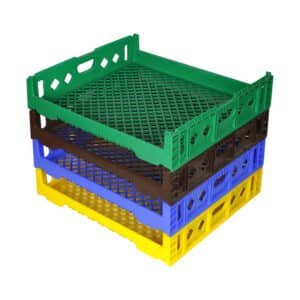
ENLIGHTENING focuses on practical product matching. We help buyers choose trays based on real bakery use, not only catalog size.
Why Choose ENLIGHTENING Plastic Bakery Trays?
ENLIGHTENING supplies plastic trays, crates, buckets, and food handling products for bakery, logistics, agriculture, cleaning, and industrial use. For bakery production, we focus on clean material, airflow, stacking stability, and easy cleaning.
Our plastic bakery trays can support:
- Food-grade bakery handling.
- Bread, toast, bun, and pastry cooling.
- Custom tray size and structure.
- Stable stacking on racks and carts.
- Easy cleaning after daily use.
- Bulk supply for bakeries and distributors.
- OEM color and logo options.
Send us your bread size, tray size, rack drawing, daily output, washing method, and target quantity. We will recommend plastic bakery trays that fit your bakery production line and delivery process.